




BLOGSDETAILS
Industrial Screw Conveyor Explained: Types and Applications
Author:hanzhe Time:2026-10-08 18:29:52 Click:51
An industrial screw conveyor looks like the simplest piece of equipment on a plant floor, and that is exactly why so many of them are specified badly. A helical flight turning inside a trough or tube does one job: move bulk material a fixed distance at a controlled rate. Whether that job is done reliably for ten years or becomes a weekly maintenance item depends almost entirely on how well the screw diameter, pitch, speed, trough loading and construction material match the material actually being handled.
In dust collection and bulk handling systems, the screw conveyor is rarely the headline equipment. It sits under a baghouse hopper, behind a rotary airlock, or between a silo and a mixer, quietly deciding whether the whole system runs or backs up. This guide explains how screw conveyors work, which configurations exist, where each one fits, and what to settle before requesting a quotation.
What an Industrial Screw Conveyor Actually Does
A screw conveyor is a continuous volumetric conveying device. Material enters through an inlet, is pushed forward by the rotating helical flight, and discharges at the far end. The conveying action depends on the material sliding against the trough or tube rather than rotating with the flight, which is why friction characteristics, moisture and particle shape matter as much as motor power.
Because the feed and discharge are physically separated and the enclosure can be sealed, the screw conveyor also functions as a metering device, a dust-tight transfer point and a cooling or heating element when a jacketed casing is used. That combination of functions is why it appears everywhere from cement plants to food processing lines, and why one specification rarely fits two applications.
Why it matters in a dust collection system
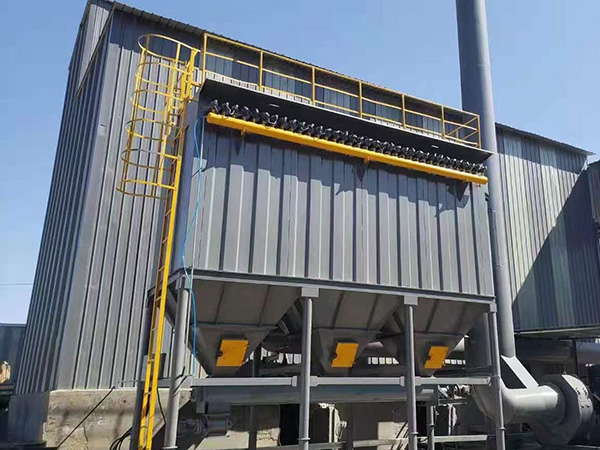
Baghouse and cartridge dust collectors discharge collected dust from hoppers. That dust has to leave the system continuously or in batches, without re-entraining into the workspace and without creating a combustible dust hazard. Screw conveyors, often paired with a rotary airlock valve, are the standard answer: a sealed, low-profile transfer that can run intermittently or continuously underneath the dust collector.
The Main Types of Screw Conveyor
Almost all screw conveyors fall into a handful of configuration families. The choice is driven by the material, the layout, hygiene or wear requirements, and how much control the process needs.
Shafted screw conveyors
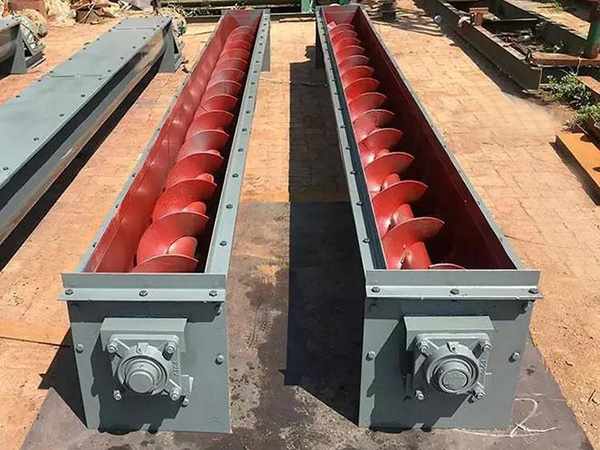
The traditional design uses a central pipe or solid shaft with flights welded to it and supported by hanger bearings at intervals. Shafted units handle free-flowing, relatively dry and non-tacky materials well, tolerate higher speeds than shaftless designs, and can convey on a slight incline. They are the default choice for grain, sand, cement, fly ash and similar granular products. Their limits show up with sticky, fibrous or wet materials that wrap around the shaft, and with long spans where hanger bearings become a maintenance point. A standard shafted configuration is described on the shaft screw conveyor product page.
Shaftless screw conveyors
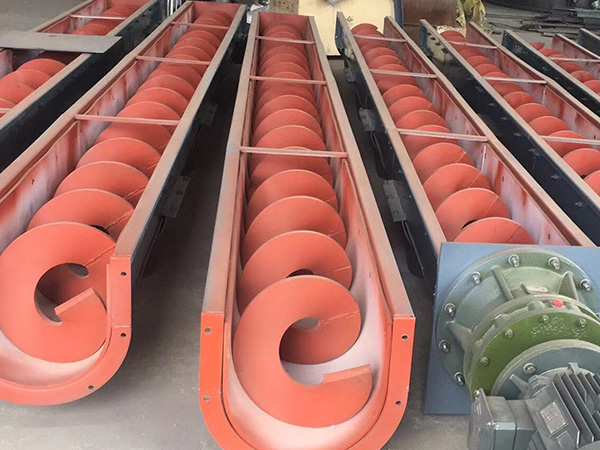
Shaftless conveyors use a heavy-section spiral with no central shaft, resting on a wear liner in the trough. The open cross-section passes stringy, sticky, dewatered or bulky materials that would otherwise bridge or wrap. The trade-off is lower allowable speed, higher torque demand and shorter flight life in abrasive duty. They are common in wastewater sludge, municipal solid waste, food waste and fibrous industrial residues.
Tubular (tube) screw conveyors
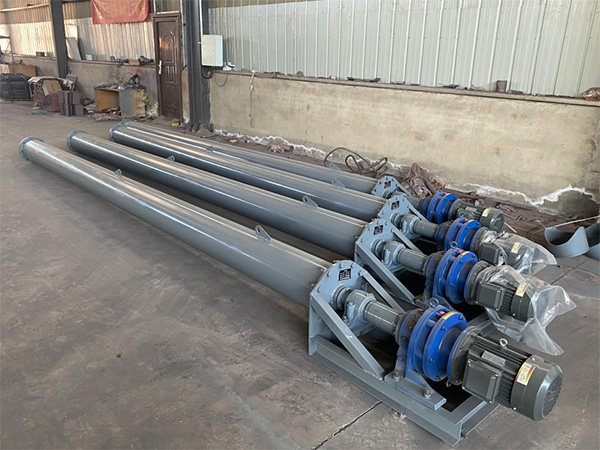
A fully enclosed round casing with the screw inside. Tubular conveyors are used where dust containment, weather protection or product purity is critical, and where the route involves short inclines or bends via flexible joints. Because the clearance between flight and tube is tight, cleanliness and material consistency matter more than in an open trough.
U-trough screw conveyors
An open-top U-shaped trough, usually covered with bolted or clamped lids. The open design gives easy access for cleaning and inspection and allows multiple inlets or discharge points along the length. U-trough conveyors are widely used for general bulk transfer inside plants, especially where operators need to see or sample the material.
Twin-shaft and multi-screw conveyors
Two parallel screws running in a common casing are used where throughput must be high but the length is short, or where the material needs mixing, blending or breaking of lumps. Twin-shaft designs also increase the available conveying cross-section for difficult materials without exceeding practical single-screw diameters.
Screw feeders
A screw feeder is a screw conveyor whose primary job is controlled volumetric feeding rather than long-distance transfer. Flight pitch is often variable, so material is drawn evenly along the inlet and delivered at a stable rate to a downstream process. Feed accuracy depends on consistent material bulk density and on the inlet geometry, which is why feeders and conveyors should not be specified interchangeably.
Design Variables That Decide Performance
Two conveyors with the same overall length can behave completely differently. The variables below are the ones that matter in practice.
Screw diameter and pitch — together they set the volume available per revolution. Pitch equal to diameter is common for general conveying; shorter pitch reduces the risk of flooding in feeders and inclines.
Rotational speed — capacity rises with speed up to the point where material no longer discharges cleanly. Abrasive or fragile products usually run slower.
Trough loading — the proportion of the casing cross-section filled. Materials with poor flow characteristics need a lower fill level, which reduces capacity at the same diameter.
Inclination — horizontal conveying is the most efficient. Every degree of incline reduces effective capacity, and steep angles often require shorter pitch or modified flighting.
Bulk density and particle size — determine the mass throughput and the wear pattern. A conveyor sized by volume can still be overloaded by mass.
Material behaviour — moisture, stickiness, abrasiveness, corrosiveness and temperature decide the casing material, flight thickness and whether a shafted or shaftless design is even viable.
Drive and control — gearbox sizing, motor starting method and the option of variable frequency control determine how gently the conveyor starts under a full trough load.
None of these can be fixed independently. Raising speed to increase capacity, for example, often increases wear and re-entrainment in dusty duties, so the correct answer is usually a larger diameter running slower.
Materials, Wear Parts and Construction Choices
Construction grade is where cost and service life are really decided. Carbon steel is the economical standard for dry, non-corrosive bulk materials and is available as a standard screw conveyor build. Stainless steel grades enter the picture for food, chemical and wet or acidic duties. On abrasive products such as foundry sand, cement clinker or ash, hardened flight edges, thicker flights and replaceable trough liners extend life far more cheaply than frequent replacement of complete screws.
Other parts that quietly determine uptime include hanger or end bearings, shaft seals at the drive end, inspection and clean-out covers, and the type of discharge opening. In dust collection service, the seal arrangement and the presence of an airlock or flap at the outlet often matter more than the conveyor itself, because they prevent air from being pulled back through the casing.
Where Screw Conveyors Are Used
Applications are broad, but the pattern repeats: a defined inlet, a controlled flow path and an outlet that must be sealed or metered.
Cement, lime and aggregate plants — raw meal, clinker dust and kiln bypass dust transfer.
Foundries and metal processing — sand, shot and grinding dust collected under downdraft tables and dry collectors.
Biomass and energy plants — sawdust, wood chips and pellet handling, where dust explosion risk drives tight enclosures.
Chemical and pharmaceutical production — enclosed transfer of powders with controlled contamination and cleaning requirements.
Food processing — stainless or food-grade troughs for grain, sugar, starch and other regulated products.
Wastewater and environmental duty — shaftless conveyors for dewatered sludge and screenings.
Dust collection systems — hopper discharge from baghouse and cartridge collectors, usually in combination with a rotary airlock valve to maintain system pressure balance. Material compatibility and suitable products for this duty are discussed in the note on what a screw conveyor can transport in a dust collection system.
Common Problems and Maintenance Points
Blockage is the failure everyone recognises, and it is worth treating as a symptom rather than a root cause. It usually starts with something more specific: material bridging at the inlet, a hanger bearing seized by fines, excessive moisture causing build-up on the flight, or an under-sized drive that stalls under a full load. A structured approach to recurring screw conveyor blockage is more productive than simply clearing the casing each time, and it begins with confirming what the conveyor is actually being asked to move.
Wear is the second recurring issue. Abrasive dust attacks the outer flight edge and the trough bottom, so replaceable liners and hardened edges are usually the most cost-effective defence. Bearings and seals should be greased on a defined schedule, and the trough interior should be inspected for product build-up that increases drag. A screw conveyor that is inspected on a fixed interval rarely fails without warning.
What to Send When Requesting a Quotation
Accurate quotations come from accurate inputs. A supplier who is asked to guess will either pad the design or under-size it. Information worth preparing in advance includes:
Material name, bulk density, particle size range and moisture content.
Material temperature and whether it is abrasive, corrosive, sticky or explosive.
Required capacity, expressed in tonnes or cubic metres per hour, and whether it is continuous or batch.
Conveying length, angle and the vertical lift, if any.
Inlet and discharge positions, plus any intermediate feed or discharge points.
Available space, headroom and the mounting arrangement under the silo or hopper.
Available power supply, voltage and frequency, and whether variable speed is required.
Environment: indoor or outdoor, ambient temperature, dust atmosphere classification.
Cleaning, hygiene or certification requirements, and any applicable local standards.
Where the duty is unusual — hot ash, wet sludge, high dust explosibility — it is better to state the uncertainty openly and ask for a design recommendation than to force a catalogue model into the application. Design review is cheaper than a failed installation.
Safety and Combustible Dust Considerations
Screw conveyors handling combustible dust need attention to three things in particular: ignition sources, confinement and housekeeping. Mechanical friction from a misaligned flight or a seized bearing, static accumulation on non-conductive parts, and tramp metal entering the inlet are all realistic ignition routes. Because the casing is enclosed, an internal deflagration can pressurise the conveyor, so explosion venting, isolation devices or inerting may need to be considered together with the dust collector design. Requirements vary by jurisdiction and material; a combustible dust hazard assessment specific to the plant is the right starting point.
FAQ
What is the difference between a screw conveyor and a screw feeder?
A screw conveyor is designed to move material from one point to another at a defined rate. A screw feeder is designed to control that rate precisely, usually with variable pitch flighting and an inlet shaped to draw material evenly. A conveyor used as a feeder often floods or delivers an unstable rate, while a feeder used for long transfer can be unnecessarily expensive.
When should a shaftless screw conveyor be used instead of a shafted one?
Choose shaftless when the material is stringy, sticky, fibrous, dewatered or bulky enough to wrap around a central shaft or to bridge in a narrow trough. Choose shafted when the material flows freely and the application needs higher speed, longer life and simpler bearings. Abrasive dry dust generally performs better in a shafted design with hardened flights and liners.
Can an industrial screw conveyor handle hot material?
It can, within limits set by the temperature resistance of the casing, flights, bearings and seals, and by thermal expansion along the length. Hot duties normally require high-temperature bearings, adequate expansion allowance and sometimes a jacketed or insulated casing. Because acceptable temperatures depend on the specific build, the material temperature and the expected peaks should always be stated in the enquiry.
How do I stop an industrial screw conveyor from blocking?
Match the trough loading to the material's flow behaviour, keep moisture out of the casing, install a correctly sized drive, and avoid feeding material faster than the screw can clear it. Eliminating hanger bearings in sticky duty, sealing the outlet properly and inspecting the trough on a fixed interval removes most blockage causes.
What capacity information is needed for sizing?
Two numbers matter most: the material bulk density and the target mass throughput. From there, screw diameter, pitch and speed can be selected together with the shaft and drive. Providing only a volume figure without bulk density is the most common cause of under-sized screw conveyors.
References
Conveyor Equipment Manufacturers Association (CEMA), ANSI/CEMA 350: Screw Conveyors for Bulk Materials, current edition.
Perry, R.H. and Green, D.W. (eds.), Perry's Chemical Engineers' Handbook, 9th ed., McGraw-Hill, sections on solids handling and conveying.
Klinzing, G.E., Rizk, F., Marcus, R. and Leung, L.S., Pneumatic Conveying of Solids: A Theoretical and Practical Approach, Springer.
National Fire Protection Association, NFPA 652: Standard on the Fundamentals of Combustible Dust, current edition.
U.S. Occupational Safety and Health Administration, Combustible Dust National Emphasis Program, OSHA Directive CPL 03-00-008.
Conclusion
The core engineering questions behind an industrial screw conveyor are the same in every industry: what is the material, how much must move per hour, over what distance and angle, and under what temperature, moisture and dust conditions. Answer those honestly and the type follows almost automatically — shafted for free-flowing and abrasive duty, shaftless for sticky and stringy materials, tubular where containment matters, U-trough where access matters, twin-shaft or feeders where throughput or control is the priority.
The real value shows up in the daily operation of the plant. A correctly specified conveyor keeps dust moving out of a collector hopper without leakage, avoids the blockage events that shut down a production line, and consumes wear parts predictably instead of unpredictably. That is a lower cost of ownership than any purchase price comparison will show.
If you are sizing a conveyor for a dust collection or bulk handling system, send the material data, capacity, layout and power details with your enquiry. Our engineering team at Hanzhe Environmental Protection will come back with a configuration recommendation and the specification points that need confirming, rather than a generic catalogue number. You can also review the full range on the product centre page.
 HOT PRODUCT
 CONTACT US