




BLOGSDETAILS
Industrial Dust Collector Buying Guide 2026
Author:hanzhe Time:2026-10-05 14:42:20 Click:78
Buying an industrial dust collector is not the same as buying a fan with a filter attached. The collector has to match a specific dust, a specific process cycle and a specific compliance obligation, and it has to do so for years while its filter media progressively load with material. Most disappointing installations trace back to one of three omissions: the dust was never properly characterised, the sizing was based on a nominal airflow figure rather than the real operating point, or the auxiliary components that keep the system running were treated as optional extras.
This guide is structured around the sequence a competent buyer actually follows, from dust data to supplier evaluation. It covers what to specify, what to ask, and where the cost of ownership really sits.
Start With the Dust, Not the Equipment
Two plants can run apparently identical processes and require different collectors, because the dust differs. Before any equipment is discussed, the following characteristics should be established, ideally from sampling rather than assumption.
Particle size distribution — dust that is largely sub-micron behaves differently from coarse shavings, and it determines whether a fabric filter, a cartridge element or a pre-separator is the sensible first choice.
Dust loading — the mass of dust per unit volume of gas. High loadings call for pre-cleaning, larger filter area or a heavier cleaning cycle.
Bulk density and flowability — decide whether collected dust will discharge freely from the hopper or bridge, and therefore how the discharge equipment must be configured.
Moisture and temperature — warm, moist gas can condense in a collector and blind the media or cement dust onto the hopper walls. Temperature also sets the limits for media and construction.
Chemistry — corrosive or acidic constituents affect housing material and coatings.
Combustibility and explosibility — whether the dust can form an explosive atmosphere changes the whole specification, not just one component.
Process variability — peak generation during a shift, batch dumping, or seasonal humidity all affect the real operating envelope.
Where a laboratory analysis is impractical, documenting the process, the material safety data and observed behaviour is far better than quoting a generic figure.
Matching Collector Type to the Duty
Industrial collectors broadly divide into fabric filtration systems and cartridge systems, with compact and specialised units filling narrower roles. Each has a natural range.
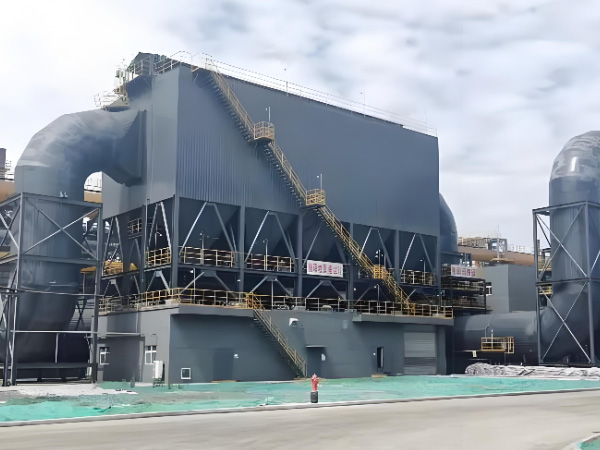
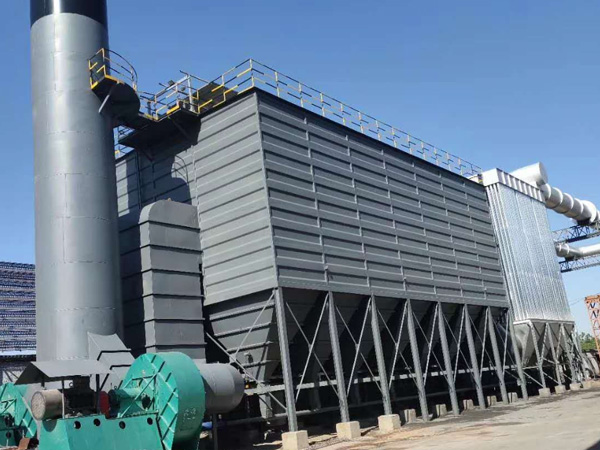
Baghouse dust collectors
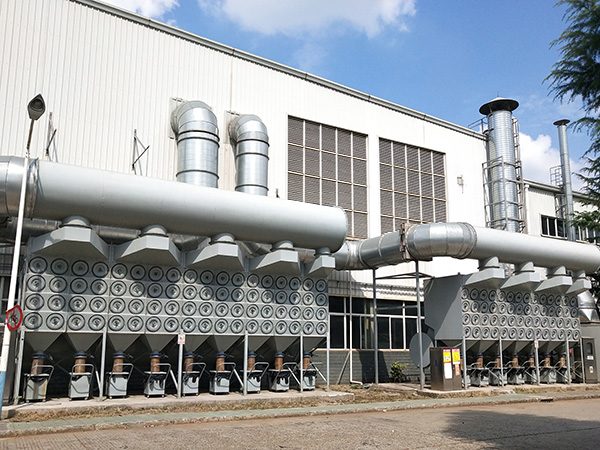
Fabric bag collectors use cylindrical filter bags in a housing, cleaned by pulses of compressed air. They suit high dust loadings, larger gas volumes and a wide range of temperatures depending on the fabric selected. A conventional baghouse handles heavy continuous duty in cement, foundry, metal processing and combustion applications. Pulse-jet cleaning allows on-line operation without shutting the unit down. The configuration, including compartment arrangements and cleaning sequences, is covered in detail on the baghouse dust collector page, and a high-efficiency heavy-duty variant is described under the pulse jet baghouse.
Cartridge dust collectors
Cartridge collectors use pleated media, which packs a large filtration area into a smaller footprint. They are a strong fit for dry, fine, free-flowing dust from metalworking, laser and plasma cutting, welding, powder handling and similar processes where space is tight and the dust is not excessively sticky or fibrous. Because pleats can retain material, they are less suitable for oily, moist or very coarse dust. Application guidance is available in the existing cartridge dust collector buying guide, and the hardware range is listed under cartridge dust collectors.
Compact and specialised units
Small baghouse and cabinet-style collectors serve isolated workstations or low-volume processes where a full-size system is disproportionate. Source-capture equipment such as a grinding downdraft table integrates capture and filtration in one unit, which is usually more effective than collecting dust after it has dispersed into the shop.
In many plants the correct answer is a combination: source capture at the process, a main collector for the residual volume, and a pre-separator where large or hot particles would otherwise reach the media.
Sizing: Airflow, Air-to-Cloth Ratio and Filter Area
Sizing errors are expensive because they cannot be corrected by adding filter bags. Three numbers govern the design.
Capture volume — the airflow needed at each hood, enclosure or pickup point to capture the dust at source. This comes from hood design and duct layout, not from the collector.
System airflow — capture volume plus the allowance for duct leakage and any future pickup points, corrected to the actual gas temperature and pressure at the collector.
Air-to-cloth ratio — airflow divided by filtration area. A lower ratio means gentler filtration, lower pressure drop and longer media life; a higher ratio means a smaller, cheaper collector running harder.
The appropriate ratio depends on the dust and the cleaning method, and should be selected conservatively for fine, sticky or high-loading dust. Under-sizing filtration area is the most common cause of high differential pressure, frequent cleaning cycles, premature media failure and dust carry-over into the atmosphere. Where the process is expected to grow, designing in filter area headroom is far cheaper than replacing the collector later.
Filter Media Selection
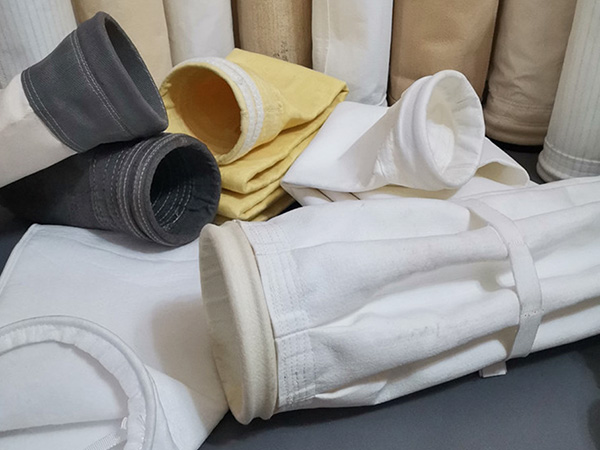
The media is the consumable that determines both emission performance and running cost. Selection should consider temperature limits, resistance to moisture and chemical attack, abrasion resistance, and whether a surface treatment or membrane is needed to prevent fine particles from embedding in the fabric. Standard woven fabrics suit general duty; needled felts with a surface finish, and membrane-coated media, are used where fine dust must be captured reliably or where cleaning efficiency is critical.
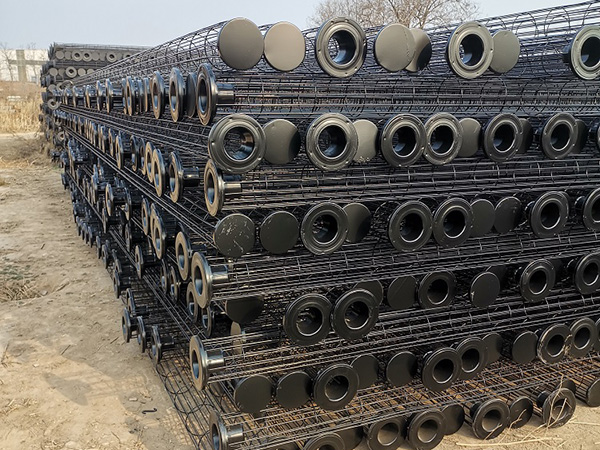
Support components matter as much as the fabric. Filter bags need correctly sized filter bag cages to prevent collapse, and the filter bag itself must be matched to the cleaning intensity the collector applies. Installing a premium media on an over-rated collector still produces poor results, while a correctly rated media on a properly sized collector is usually the lowest-cost solution over the media's life.
Auxiliary Components That Decide Uptime
Collectors fail in service more often because of auxiliaries than because of the housing or the fan.
Pulse jet valves — cleaning reliability depends on valve response and diaphragm condition. Their working principle is explained in the article on pulse jet valve operation, and the components are listed under pulse jet valves.
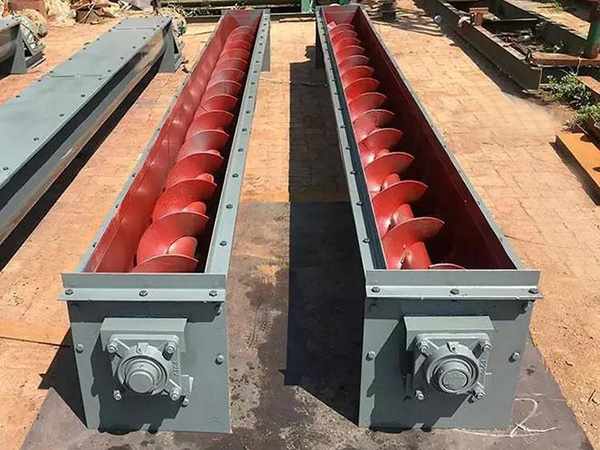
Discharge equipment — a rotary airlock valve maintains the pressure seal under the hopper, and a screw conveyor transfers the dust away. Undersized discharge equipment causes hopper build-up and re-entrainment.
Ducting and hoods — the collector cannot capture what the hoods never collect. Duct velocities must be high enough to keep dust in suspension without wasting energy.
Instrumentation — differential pressure indication is the minimum. It is the only simple signal that tells an operator whether the media and cleaning system are healthy.
Access and safety features — platforms, inspection doors, explosion vents where required, and a maintenance route that does not involve dismantling ductwork.
Compliance, Safety and Combustible Dust
Emission limits depend on the jurisdiction, the process and the pollutant, so the applicable local standard should be identified at the start rather than assumed. Where combustible dust is present, the design must also address ignition control, confinement of a potential deflagration, isolation between connected equipment and housekeeping practice. These requirements interact: an explosion vent on the collector is only effective if the ductwork and discharge equipment isolate the pressure wave properly, and the discharge valve must not become an ignition source through friction or sparks.
Buyers should ask for the documentation that supports the offer — material and construction details, media specification, cleaning system description and the assumptions used in sizing. A supplier who cannot state the assumed air-to-cloth ratio, dust loading and capture volume has not really designed anything.
Cost of Ownership Beyond Purchase Price
Purchase price is the smallest part of the long-run cost in most installations. The bigger drivers are energy consumption of the fan, compressed air consumed by pulse cleaning, media replacement frequency, wear-part replacement in valves and conveyors, and downtime when a collector has to be taken offline. A collector with generous filtration area usually runs at lower differential pressure, which reduces fan energy and allows longer cleaning intervals — the saving accumulates quietly over years.
Comparison should therefore be made on a like-for-like basis: same dust, same airflow, same emission target, same media, and a stated service assumption for cleaning cycles and media life. For unusual or demanding duties, a purpose-built configuration may be more economical than a catalogue unit forced onto the application; the options are described in the article on custom dust collection solutions.
What to Send in an RFQ
A well-prepared enquiry shortens the technical exchange and reduces the risk of an unsuitable offer. Include the following.
Process description, material handled and dust source points.
Dust data: particle size range, loading, bulk density, moisture, temperature, chemistry, combustibility.
Required airflow at each pickup point, duct layout and total static pressure if known.
Required collection efficiency and any applicable emission limit or internal standard.
Operating schedule: hours per day, continuous or batch, peak conditions.
Space constraints, mounting arrangements and indoor or outdoor installation.
Power supply, compressed air supply and control interface expectations.
Discharge and disposal route, including bin, conveyor or pneumatic line.
Cleaning, hygiene, explosion-protection or certification requirements.
Documentation expectations: drawings, materials of construction, media specification, commissioning support and spare parts.
FAQ
How do I choose between a baghouse and a cartridge dust collector?
Compare the dust rather than the budget first. Cartridge collectors suit dry, free-flowing fine dust where a compact footprint matters and the material does not blind pleats. Baghouses suit high loadings, larger volumes, hotter gas and dust that is sticky, fibrous, oily or abrasive. Where the dust is marginal, a pilot test on a small unit is more informative than a specification comparison.
What air-to-cloth ratio should an industrial dust collector use?
There is no universal figure. The right ratio depends on particle size, dust loading, cleaning method and whether the process runs continuously. Fine, sticky or high-loading dust needs a lower ratio, meaning more filtration area for the same airflow. Ask the supplier to state the assumed ratio and the reason behind it, and treat unusually high ratios as a warning sign.
How long should dust collector filter media last?
Media life is set by cleaning intensity, abrasion, moisture and chemical exposure rather than by a fixed calendar interval. A correctly sized collector running at moderate differential pressure with a healthy cleaning system will generally consume less media than one that is under-sized and constantly cleaning. Tracking differential pressure over time is the practical way to plan replacement instead of reacting to failures.
Can a dust collector be added to an existing process without major works?
Often yes, but the limiting factors are usually space, duct routing, power supply and the structural support available for the collector and its discharge equipment. Retrofits also need a fresh sizing exercise, because tying a new collector into existing ductwork changes the airflow balance across the whole system.
What documentation should accompany a dust collector offer?
At minimum: a dimensioned general arrangement drawing, materials of construction, filter media specification with area and air-to-cloth ratio, cleaning system details, fan and motor data, and a list of the assumptions used in sizing. For hazardous duties, the explosion-protection and isolation provisions should be documented explicitly.
References
U.S. Environmental Protection Agency, Air Pollution Control Technology Fact Sheets, including the fabric filter (baghouse) fact sheet series.
ACGIH, Industrial Ventilation: A Manual of Recommended Practice for Design, current edition.
National Fire Protection Association, NFPA 652: Standard on the Fundamentals of Combustible Dust, current edition.
National Fire Protection Association, NFPA 654: Standard for the Prevention of Fire and Dust Explosions from the Manufacturing, Processing, and Handling of Combustible Particulate Solids, current edition.
Vatavuk, W.M., Estimating Costs of Air Pollution Control, CRC Press.
Conclusion
The technical problem in buying an industrial dust collector is matching an airflow and an emission target to a dust that behaves in a specific way. The important considerations follow from that: duct and hood capture first, system airflow second, filtration area third, then media selection, cleaning system reliability and discharge equipment that will not back up. Compliance and combustible dust requirements sit across all of it, not alongside it.
Judged on those factors, the practical value of a properly specified collector is not a purchase order that came in low. It is a system that holds its emission performance, keeps differential pressure stable, and consumes media and wear parts predictably — which is what makes operating cost visible and controllable. A collector bought on price alone usually returns the difference later in fan energy, media and unplanned downtime.
If you are replacing an underperforming unit or specifying a new one, send us the dust data, capture points, airflow and any emission limits. The engineering team will review the sizing assumptions, recommend a configuration and highlight the specification points that still need confirming. Related equipment is listed in the product centre, and practical installation examples are shown in the case studies.
 HOT PRODUCT
 CONTACT US