




BLOGSDETAILS
Industrial Air Pollution Control Equipment Guide
Author:hanzhe Time:2026-10-02 13:18:38 Click:198
Industrial air pollution control equipment is usually discussed as a list of devices — dust collector, scrubber, adsorber, oxidiser — as if a plant only had to pick one. In practice the exhaust stream almost always carries more than one pollutant family, and the equipment has to be assembled into a sequence that works as a system. A coating line may release solvent vapour, overspray particulate and odour. A metal finishing shop may release acid mist, metal fines and oil smoke from the same roof. Choosing the right devices is only half the job; the other half is deciding the order, the operating conditions and the duty split between them.
This guide sets out how that decision is normally made, from characterising the exhaust to specifying, integrating and maintaining the equipment package.
What the Exhaust Stream Actually Contains
Pollutants behave differently and therefore need different removal mechanisms. Characterising the stream by family is the first step.
Particulate matter — dust, fume, smoke and mist. Removed mechanically by filtration, inertia or electrostatic forces.
Acid gases and water-soluble pollutants — sulphur dioxide, hydrogen chloride, hydrogen fluoride, ammonia and similar compounds. Removed by absorption into a scrubbing liquid.
Volatile organic compounds (VOCs) — solvents and hydrocarbons. Removed by adsorption onto a solid medium, by thermal or catalytic destruction, or by biological treatment in suitable cases.
Odour and trace organics — often present at low concentration but high nuisance value, frequently addressed with the same equipment used for VOCs.
Physical conditions — temperature, moisture, acidity, dust loading and flow variation. These often decide which technologies are feasible before pollutant concentration is even considered.
Concentration and flow rate complete the picture. Dilute, high-volume streams and concentrated, low-volume streams can carry the same mass of pollutant but rarely suit the same equipment.
Capture Comes Before Treatment
No treatment device can remove what never reaches it. Hood design, enclosure, duct velocity and make-up air determine how much of the emitted pollutant is actually collected. A plant that invests in a treatment stage while the capture system leaks at the hood is paying twice — once for treatment capacity it does not need and once for the emissions that escape it.
Capture and containment should be reviewed as part of the pollution control project, not treated as existing infrastructure. Changes to enclosure or local exhaust ventilation normally reduce the required treatment capacity, which improves both capital and operating cost.
Particulate Control
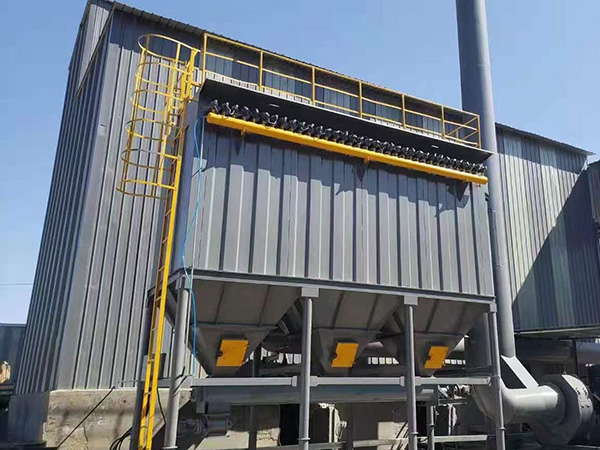
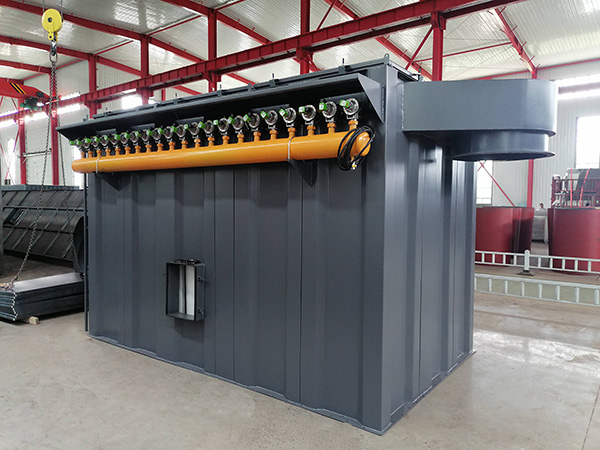
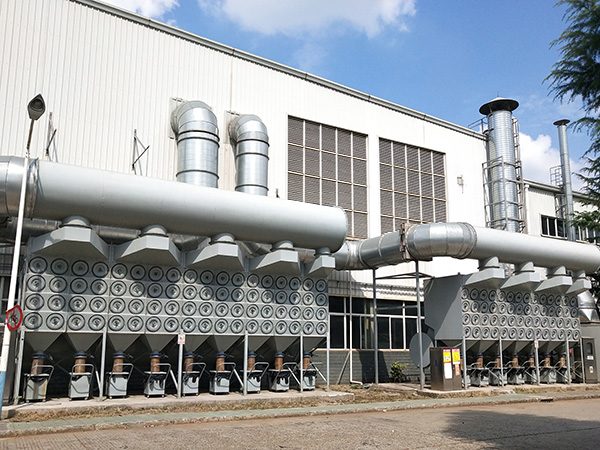
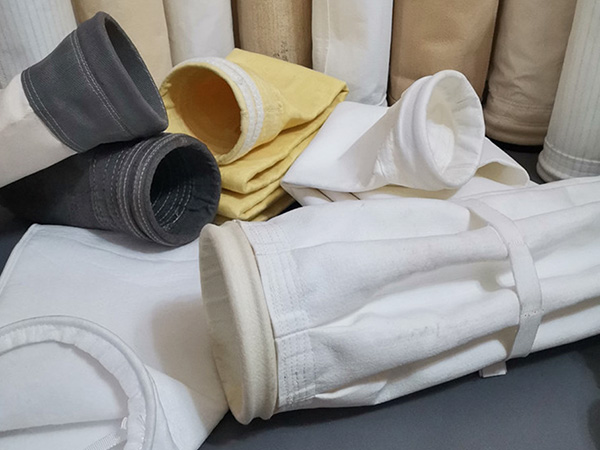
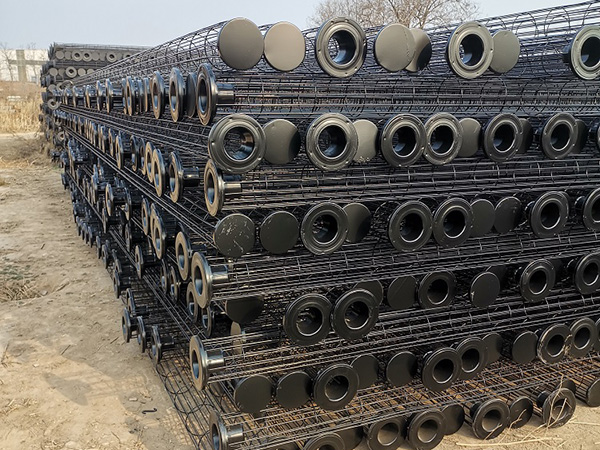
Where the dominant pollutant is dust or fume, fabric filtration is the standard approach. Baghouse collectors handle high loadings and larger gas volumes, and suit a wide range of temperatures depending on the bag material. Cartridge collectors pack filtration area into a smaller footprint and work well on dry, free-flowing fine dust from metalworking, cutting and powder handling.
The choice between them is driven by the dust rather than the plant type. Sticky, oily, fibrous or very abrasive dust is usually better served by a baghouse, while compact cartridge units are often more economical for workstation-scale extraction. Where large particles or sparks are present, a pre-separator or spark arrestor upstream protects the media and reduces fire risk. The available options are grouped under baghouse dust collectors and cartridge dust collectors. Where the emission point is a workshop activity rather than a ducted process, source capture equipment such as a grinding downdraft table combines capture and filtration in a single unit.
Acid Gas and Water-Soluble Pollutant Control
Absorption in a scrubbing liquid is the established method for acid gases, ammonia and water-soluble compounds. A spray tower uses the same principle with a simpler internal arrangement: gas rises through a chamber while liquid is sprayed downwards, and soluble pollutants transfer into the liquid phase. The design is relatively open internally, which makes it tolerant of moderate particulate loads and comparatively low maintenance compared with packed scrubbers, though the achievable removal efficiency for very soluble gases depends on contact time, liquid-to-gas ratio and pH control.
Material selection is the practical dividing line. Corrosive exhaust demands corrosion-resistant construction, which is why fibreglass-reinforced plastic units are widely used — see the spray tower range and the FRP spray tower option. Operational success depends on far more than the vessel: liquid distribution, pH and dosing control, mist elimination, sludge handling and the corrosion protection of the discharge ducting all need design attention. Recirculation water that is not managed will eventually scale, corrode or lose absorption capacity.
Practical limitations are worth stating upfront. Scrubbing produces a liquid effluent that must be treated or recycled, so a wet system adds a water treatment obligation. Very low-solubility organic compounds are poorly absorbed and generally belong to a different technology.
VOC and Odour Control
VOC treatment divides broadly into recovery and destruction approaches, and the choice is dominated by concentration, flow rate, solvent value and the presence of other pollutants.
Adsorption on activated carbon
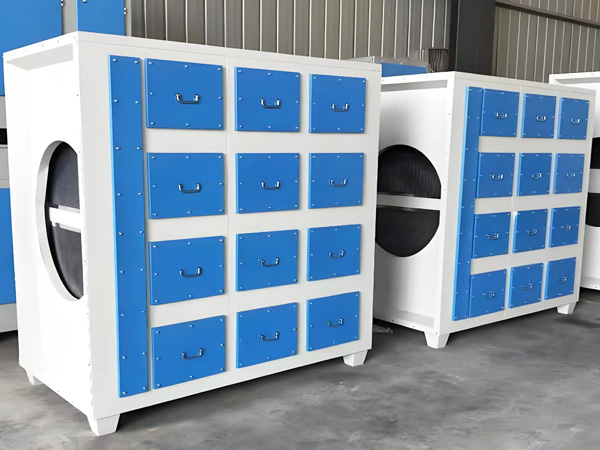
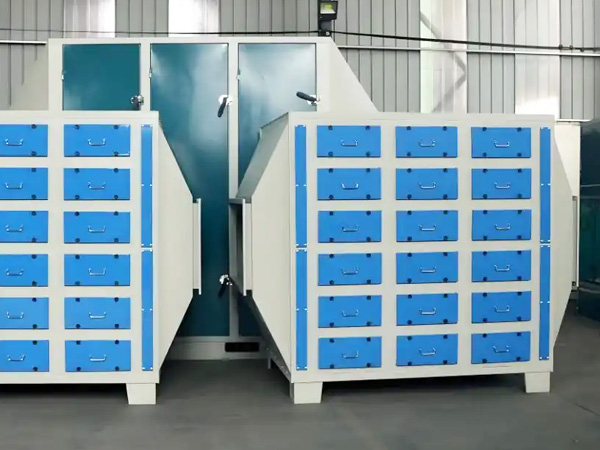
Activated carbon adsorbers capture organic vapours onto a porous medium. They are well suited to relatively low concentrations, to intermittent processes and to applications where the solvent can be recovered or where a low-temperature, low-energy solution is preferred. The limits are practical: high humidity competes with adsorption, high concentrations shorten working capacity and generate heat, and the spent carbon — or a regeneration system — becomes a recurring operating cost and a waste management obligation. A standard configuration is shown under the activated carbon adsorption box.
Catalytic oxidation
Catalytic oxidation destroys VOCs by oxidising them over a catalyst at lower temperature than thermal incineration, which reduces fuel consumption. It suits continuous streams with moderate concentrations and is often used where destruction rather than recovery is required. Its limitations are equally specific: certain compounds poison or foul the catalyst, particulate and mist should be removed upstream, and operation is normally most economical within a defined concentration band. Where concentrations run higher, thermal recovery or a different arrangement may be more appropriate.
Combining the two
Concentration and destruction stages are frequently paired. Adsorption can concentrate a large dilute stream before oxidation, and a dust or scrubber stage placed in front protects both from particulate and acid attack. The technology description for VOC streams, including compliance considerations, is covered in the existing article on industrial VOC treatment solutions. A detailed variant is discussed in the article on whether a given VOC concentration suits catalytic combustion.
Sequencing Multiple Stages
Once more than one pollutant family is present, the arrangement matters as much as the individual units.
Particulate removal first where possible. Dust and mist degrade adsorption media, poison catalysts and load scrubber internals.
Temperature management between stages. Adsorption and most biological processes require cooled gas, while oxidation processes need the stream within the catalyst's operating window.
Pressure balance across the train. Each stage adds resistance, and the fan or fans must be positioned so that leakage draws air inward at hazardous points rather than pushing contaminated gas outward.
Duct and fan material selection suited to the most aggressive condition in that segment, not to average conditions.
Bypass and upset handling. The design should define what happens when a process starts up, when a batch dumps, or when a treatment stage goes offline, because uncontrolled bypass is a common cause of exceedance.
Instrumentation across the train, including pressure differential, temperature and, where required, continuous emission monitoring points.
Compliance, Monitoring and Documentation
Emission requirements are jurisdiction-specific and depend on the pollutant, the process and the plant's permitting status. As a general rule, plants should establish the applicable limits, the required monitoring method and the reporting obligations before equipment selection, because they affect capture design, treatment efficiency, instrumentation and even the choice between wet and dry systems.
Documentation expectations are also practical. A complete package normally includes a process flow diagram, the mass balance showing inlet and outlet pollutant loads, equipment datasheets with materials of construction, control philosophy, utility requirements and commissioning records. For plants subject to periodic testing, the sampling locations must be designed into the ductwork from the start.
Commissioning, Operation and Maintenance
Pollution control equipment rarely fails suddenly; it drifts. Filter media loads slowly, scrubber nozzles scale, carbon saturates, catalysts degrade, and hood capture falls as processes change. Commissioning with measured baselines — differential pressure, liquid-to-gas ratio, scrubbing pH, adsorption breakthrough and oxidation outlet temperature — gives the maintenance team something to compare against later.
A practical maintenance plan covers media replacement intervals, nozzle and pump inspection, pH and dosing control verification, carbon working capacity checks, catalyst inspection, and periodic re-verification of hood capture. The installed system examples and application scenarios on this site illustrate how these stages are arranged in real installations.
Cost Factors to Compare
Capital cost reflects equipment size, materials of construction, instrumentation and the extent of the ductwork change. Operating cost is where the differences between technologies become visible.
Energy — fan power across the whole system, plus any heating required for oxidation processes.
Consumables — filter media, scrubber chemicals and water treatment, activated carbon, catalyst replacement.
Utilities — compressed air for pulse cleaning, water and steam, electricity for pumps and controls.
Waste handling — dust disposal, spent media and carbon, scrubber sludge or effluent.
Maintenance labour and spares — valves, nozzles, seals, wear parts, and the downtime required to replace them.
Compliance risk — the cost of an exceedance, whether measured as penalty, production restriction or reputational damage, is the reason efficiency headroom usually pays for itself.
FAQ
How do I choose the right pollution control equipment for my process?
Start from the exhaust stream rather than the equipment list: identify each pollutant family, its concentration and the physical conditions of the gas. Then determine the capture volume, and only afterwards select treatment stages. Most selection errors come from choosing a device before the stream has been fully characterised.
Can one unit handle dust, acid gas and VOCs at the same time?
Rarely well. Wet scrubbers can remove particulate and soluble gases together, but they are ineffective for low-solubility organics. Filtration removes particulate but not gases or vapours. Most multi-pollutant streams are handled as a train: particulate removal, then scrubbing, then adsorption or oxidation, with temperature and pressure managed between stages.
Is a wet scrubber or a dry dust collector better for my application?
It depends on what must be removed. Dry fabric or cartridge filtration is usually more efficient for fine dry particulate and produces a solid waste stream that is simple to handle. Wet scrubbing suits acid gases, water-soluble pollutants, sticky or combustible dust and hot or moist streams, but it creates a liquid effluent and requires water treatment.
When is activated carbon adsorption appropriate for VOC control?
Adsorption is generally a good fit for low to moderate concentrations, intermittent operation and cases where solvent recovery or low energy consumption matters. It becomes less suitable as humidity, concentration and temperature rise, and the cost and regulatory handling of spent carbon must be included in the comparison from the beginning.
What information should be provided when requesting a pollution control system quotation?
Supplied by process stage: pollutant types and expected concentrations, exhaust flow rate and temperature, moisture and dust loading, capture points and duct layout, operating schedule and variability, available utilities and space, applicable emission limits and monitoring requirements, and any explosion-protection or corrosive-duty constraints.
References
U.S. Environmental Protection Agency, Air Pollution Control Technology Fact Sheets, including fabric filter, wet scrubber and thermal/catalytic oxidiser fact sheets.
European Commission, Best Available Techniques (BAT) Reference Document for Common Waste Gas Treatment in the Chemical Sector, Joint Research Centre.
Directive 2010/75/EU of the European Parliament and of the Council on industrial emissions (Integrated Pollution Prevention and Control).
Ministry of Environmental Protection of the People's Republic of China, GB 16297-1996: Integrated Emission Standard of Air Pollutants.
ACGIH, Industrial Ventilation: A Manual of Recommended Practice for Design, current edition.
Conclusion
The core technical problem in air pollution control is that one exhaust stream usually contains several pollutant families, each requiring a different removal mechanism, under physical conditions that may favour one technology and rule out another. Capture design, flow rate, concentration, temperature, moisture and corrosivity therefore decide more of the outcome than the equipment brand does.
The considerations that follow are sequence, protection and measurement: particulate removal ahead of media and catalysts, temperature and pressure balanced across the train, materials chosen for the worst condition in each segment, and instrumentation that shows whether performance is holding. Selection factors come down to the pollutants present, the concentration band, the operating schedule and the utility and waste obligations each technology creates. Judged that way, the practical value of the right package is a system that stays within its limits without consuming disproportionate energy, chemicals and maintenance attention.
If you are planning a new treatment train or fixing one that does not hold its performance, send us the exhaust data, capture layout and applicable limits. The engineering team will review the stream characterisation, recommend a stage sequence and identify the points that still need confirming. The full equipment range is listed in the product centre.
 HOT PRODUCT
 CONTACT US